



CR1220 battery vs other coin cell batteries differences and selection guide
You open your key fob and discover the battery label requires a CR1220. The store shelf shows CR1216, CR1225, CR2025, and CR2032. How does the CR1220 battery compare to these alternatives, and how do you choose correctly? Thickness compatibility is the critical factor that makes or breaks your device's fit. You also need to understand size, capacity, voltage, application scenarios, and a step-by-step selection method. These factors guide you to the right replacement. Getting it wrong can damage your device or cause poor performance. The right choice ensures reliable power and long life for your device.
Key Takeaways
The CR1220 battery has a 12.5 mm diameter and 2.0 mm thickness. Thickness decides compatibility.
All CR series coin cells deliver 3 volts. You do not need to compare voltage between them.
Only substitute CR1216 or CR1225 if the device maker approves. Always match the original model number first.
Check the label on your old battery. If the label is worn, measure the diameter and thickness to find the right replacement.
Never use rechargeable coin cells. They have a higher voltage and can damage your device.
Decoding coin cell names
The CR prefix and lithium chemistry
The letters at the start of a coin cell name tell you two things at once: the chemistry inside and the shape of the cell. The "C" stands for lithium manganese dioxide, or Li-MnO₂. The "R" means the cell is round. Every CR series cell shares this chemistry, and that chemistry delivers a nominal voltage of 3.0 volts. You get this same 3.0 V rating across the entire CR family, from the smallest cell to the largest.
This chemistry matters for your device because of how it discharges. Li-MnO₂ cells hold a steady voltage through most of their service life. The manufacturer datasheet describes this behavior clearly:
Li-MnO2 cells deliver a nominal OCV of 3.0V with a flat discharge plateau down to a 2.0V cut-off.
That flat plateau means your device sees consistent power instead of a slow fade. A key fob or glucose monitor keeps working reliably until the cell nears its end.
Reading the four-digit code
The four digits after the prefix encode the physical size. The International Electrotechnical Commission sets this convention in its IEC 60086 standard:
Button cell battery sizes follow the IEC 60086 code. The letters give the chemistry and shape (CR = 3V lithium, round) and the four digits give the size — first two = diameter in mm, last two = thickness in tenths of a mm. So CR2032 = lithium, round, 20 mm wide, 3.2 mm thick.
Apply this rule to the CR1220 battery and you get a 12.0 mm diameter with a 2.0 mm thickness. The first two digits, "12," give you the diameter in millimeters. The last two digits, "20," give you the thickness in tenths of a millimeter, so 2.0 mm.
You will also see equivalent part numbers from different makers. DL1220, ECR1220, and BR1220 all describe the same 12.0 mm by 2.0 mm size. One caution: BR1220 uses a different chemistry, so check the prefix before you substitute.
CR1220 battery vs other coin cells: specs
Diameter, thickness, and weight
Size separates these cells more than any other factor. The table below shows the measurements you will find across the five common models.
Battery Model | Diameter | Thickness |
|---|---|---|
CR1216 | 12.0 mm | 1.6 mm |
CR1220 | 12.0 mm | 2.0 mm |
CR1225 | 12.0 mm | 2.5 mm |
CR2025 | 20.0 mm | 2.5 mm |
CR2032 | 20.0 mm | 3.2 mm |
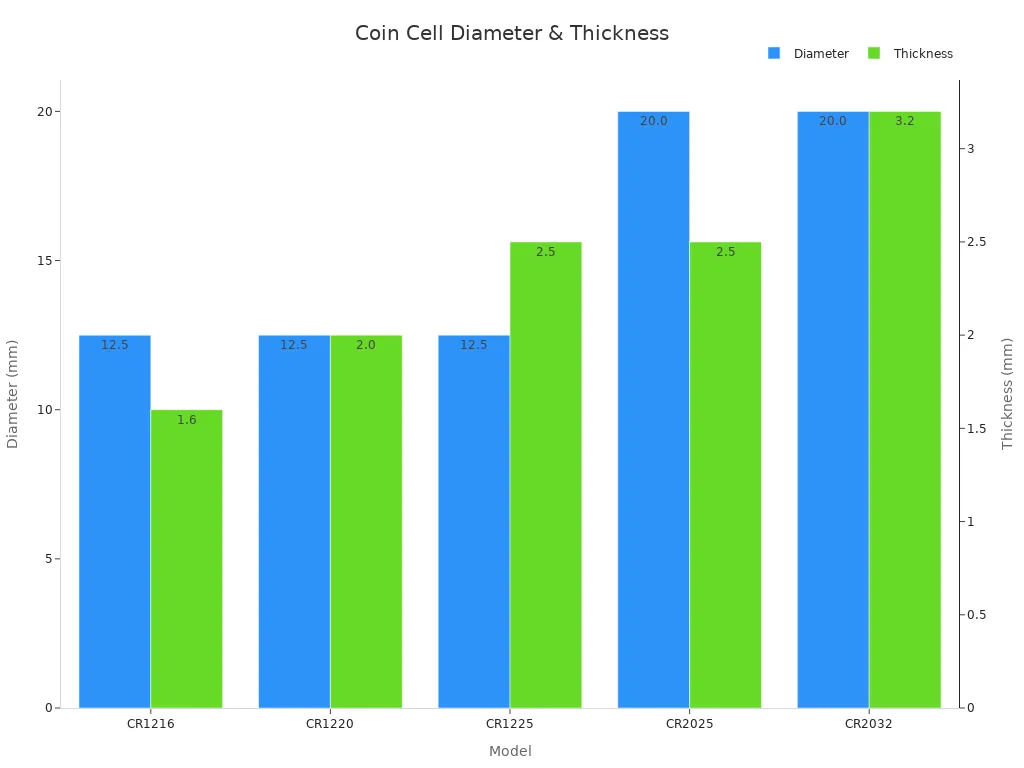
Notice the pattern. The three 12 mm cells share the same diameter but differ in thickness. The two 20 mm cells jump to a much wider footprint. A CR2025 or CR2032 will not sit inside a 12 mm slot at all. The diameter gap is too large.
Weight follows size closely. A CR1220 battery weighs only a fraction of a gram, which suits compact devices where every milligram counts. The larger CR2032 carries more mass because it holds more material inside its wider case.
Voltage, capacity, and drain current
All five models share the same 3V nominal voltage. That common rating makes them look interchangeable on paper. Capacity tells a different story.
Battery Model | Typical Capacity Range |
|---|---|
CR1216 | ~25 mAh class |
CR1220 | ~35–40 mAh class |
CR1225 | ~50 mAh class |
The CR1220 delivers 35 to 40 mAh, which places it in the middle of the 12 mm family. A CR1216 offers roughly 25 mAh, and a CR1225 reaches about 50 mAh. The CR2025 and CR2032 hold even more because their larger cases accept more active material.
Drain current matters for your device choice. Low-drain devices such as watches, key fobs, and memory backup circuits draw tiny currents and let the cell last for years. Higher-drain devices pull current faster and drain any coin cell sooner. Match the cell's capacity to your device's demand.
The CR1220 uses lithium manganese dioxide chemistry, which provides stable voltage across a wide temperature range. It holds a shelf life of up to 10 years and is designed for safe use in consumer electronics.
Why thickness decides compatibility
When a thinner cell fits but loses contact
The 12 mm coin cell family forms a thickness ladder. A CR1216 measures 1.6 mm thick, which makes it 0.4 mm thinner than a CR1220. A CR1225 measures 2.5 mm thick, which makes it 0.5 mm thicker. All three share the same 12.0 mm diameter. Only the height changes.
A thinner cell drops into the compartment with room to spare. That extra space causes real problems. The cell rattles around instead of sitting still. You may notice these symptoms:
Shaking (loose fit) of the thinner CR1216 battery inside the CR1220 compartment
Intermittent power disconnection due to poor contact
Signal failure caused by unstable electrical connection
Loose and unstable fit because the CR1220 compartment is designed for a battery that is 0.4mm thicker than the CR1216
Your device may work one moment and fail the next. A key fob might refuse to lock the car. A glucose monitor might lose its reading. The metal contacts cannot press firmly against a cell that sits too low in the slot.
When a thicker cell blocks the compartment
A thicker cell creates the opposite problem. The CR1225 adds 0.5 mm of height. That extra material pushes against the compartment lid. The lid may not close at all. Forcing it shut can bend the contacts, crack the plastic housing, or crush the cell itself.
Never press a thicker cell into place. If the lid resists, stop. The compartment was built for one specific height, and the CR1220 battery matches that height at 2.0 mm. A cell that measures 2.5 mm simply does not belong there.
Diameter and thickness must both match your device's requirements. A cell with the right diameter but the wrong height will fail you every time. Check both numbers before you buy a replacement.
Which devices use which coin cell
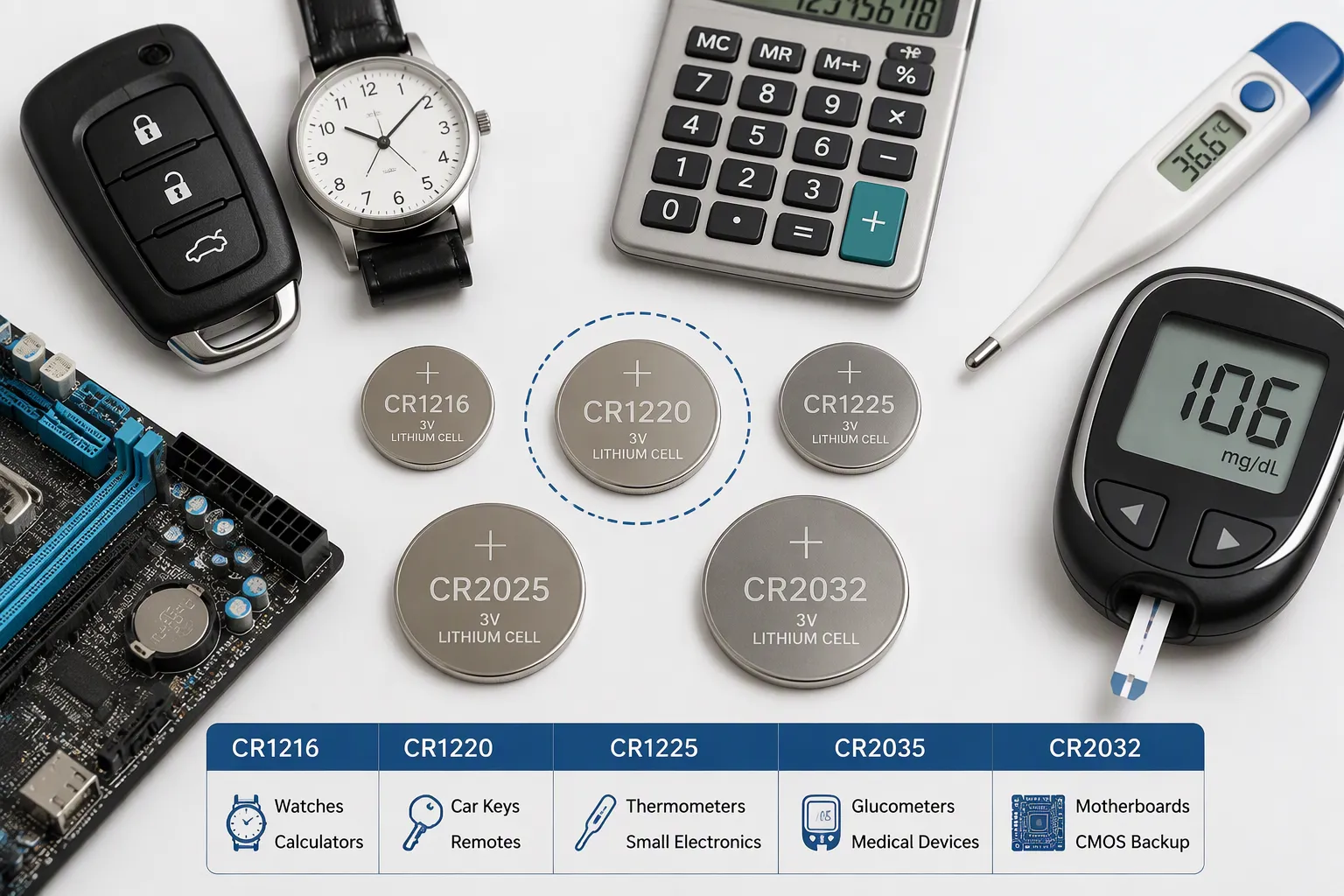
Devices that typically require a CR1220
The CR1220 battery powers many compact, low-drain devices. You find it inside key fobs that unlock your car doors. Remote controls for small electronics often use this cell. Medical devices like glucose monitors rely on its stable 3V output for accurate readings. Calculators and watches also depend on this size. Computer motherboards use the CR1220 for memory backup. When the main power goes off, this small battery keeps your BIOS settings and system clock running.
Why do these devices choose the CR1220 battery? The reason comes down to physical fit and power demand. The 12.0 mm diameter and 2.0 mm thickness match the compartments built into these products. The 35-40 mAh capacity handles the low drain these circuits need. You get years of service from a single cell in a key fob or watch. The flat discharge curve means your device sees consistent voltage until the battery nears its end. This reliability matters most for devices you depend on daily.
Devices that require CR1216, CR1225, CR2025, or CR2032
Different devices need different coin cell sizes. The CR1216 fits into ultra-thin compartments where height is the limiting factor. Several medical devices use this thinner cell because it sits inside slim housings. The list includes:
digital medical thermometers
blood glucose monitors
wearable patch monitoring devices
biomedical sensors
These devices all rely on the CR1216's low profile. For example, a wearable broadband auscultation patch called AusculPatch operates continuously for more than 10 hours using a single CR1216 coin cell. That cell measures 12 mm in diameter and 1.6 mm in height, with a capacity of 30 mAh.
The CR1225 serves devices that need more capacity but share the same 12 mm footprint. You might find it in gadgets that draw slightly more current but cannot accept a wider cell. The CR2025 and CR2032 belong to larger devices. Computer motherboards, fitness trackers, and car remote fobs often use these 20 mm cells. The extra diameter holds more active material. This gives you higher capacity for devices that run longer or draw more power.
Interchangeability and safe replacement
When substitution is acceptable
You cannot swap a CR1220 battery with a CR2025 or CR2032. The diameter difference alone rules out any substitution. A 12.0 mm cell will not fill a 20 mm slot, and a 20 mm cell will not fit into a 12 mm compartment. No amount of pressure or modification makes this work safely.
Within the 12 mm family, you have limited room to substitute. The CR1216, CR1220, and CR1225 share the same 12.0 mm diameter. Only the thickness changes across these three models. You may substitute one for another only when two conditions hold true. First, the diameter and thickness must match your device's requirements exactly. Second, the device manufacturer must approve the swap. Without both conditions, you risk poor contact or physical damage.
Some devices tolerate slight thickness variations because their contacts use spring tension. A spring-loaded contact can press against a slightly thinner cell and maintain connection. However, you cannot assume your device has this design. Check the manufacturer's documentation before you try any substitution.
Risks of forcing the wrong cell
Forcing a wrong cell into your device creates real hazards. A thicker cell pushes against the compartment lid and the internal contacts. The lid may not close. The contacts may bend or break. In severe cases, the pressure can crack the plastic housing or crush the cell itself. A crushed lithium cell can leak or rupture.
A thinner cell creates different problems. The cell sits loose in the compartment. It rattles when you move the device. The contacts lose firm pressure against the cell terminals. Your device may power on and off unpredictably. A key fob might fail to lock your car. A medical monitor might lose its reading at a critical moment.
Rechargeable coin cells have different nominal voltages and are not direct replacements for primary lithium cells like the CR1220.
A rechargeable cell has a different nominal voltage and will not match your device's 3.0 V requirement. The different voltage can damage sensitive circuits. Always match the chemistry and voltage rating before you install any replacement.
Selection guide: choosing the right coin cell
Step 1 — Check the compartment and label
Start with the original battery. Pull the old cell from the device and read the printed label. The model number gives you the exact size and chemistry you need. Write that number down before you dispose of the battery. This simple step prevents guesswork.
The label may be worn or missing after years inside the device. You cannot read what is left. In that case, use a different approach to find the correct replacement. Try these methods:
Identify the device brand and exact model number. This information narrows down compatible battery chemistries and sizes. Manufacturers design each product around one specific coin cell. Look for markings on the device housing, under a removable cover, or in the user manual.
Provide clear photographs of the front and back of the device. Capture the original battery assembly, any markings on the holder, and the model label on the body. Send these images to the battery supplier or the device manufacturer. They can evaluate the pictures and tell you the exact replacement you need.
Retain the physical original sample as a golden reference. Keep the old cell even if it is dead. Compare its diameter and thickness against any new battery before installation. A simple measurement with a ruler or calipers confirms that the new cell matches the old one in size.
These steps work together. You may only need one to find the right model. If one method fails, try another. The goal is a single piece of information: the exact battery model your device requires.
Step 2 — Match space, power, and capacity
Physical fit comes first. Any replacement must match the diameter and thickness of the compartment exactly. A CR1220 battery measures 12.0 mm in diameter and 2.0 mm in thickness. If the compartment accepts those numbers, you have the right size. Do not settle for a cell that differs even by 0.1 mm in thickness. The earlier section showed how a thinner cell loses contact and a thicker cell blocks the compartment. Diameter must match too. A 20 mm cell cannot fit into a 12 mm slot.
After you confirm the size, check the voltage. Every CR series coin cell delivers 3.0 volts. As long as you stay within the CR family made of lithium manganese dioxide, the voltage matches. Do not use rechargeable coin cells. They have different nominal voltages, which can damage sensitive circuits.
The final check is capacity. You need to ensure the battery can power your device for a reasonable time. Estimate the device's average current drain to confirm the replacement's capacity is sufficient. Here is the formula to use:
Battery Runtime (hours) = Usable Battery Capacity (Wh) ÷ Total Load Power (W)
To use this formula for sizing, rearrange it. If you know the required runtime and the load watts, you can calculate the minimum usable battery capacity needed. For low-drain devices such as key fobs or watches, the 35–40 mAh capacity provides years of service. For higher-drain devices, consider hidden loads that draw power continuously. Common hidden loads include Bluetooth modules, displays, and control boards. These small draws add up over hours of use. If you cannot identify the source of the draw, use a battery monitor to track the actual current over time. This measurement lets you verify that the replacement's capacity is sufficient.
Also confirm the chemistry and environmental compliance. Stick with reputable lithium manganese dioxide cells that are safe and compliant. These cells operate safely, offer up to 10 years of shelf life, and comply with disposal regulations. A reputable manufacturer guarantees these qualities in every cell they produce.
By following these two steps, you select a replacement that fits physically, matches the voltage requirement, and delivers enough capacity for your device.
The CR1220 battery takes its identity from two numbers: a 12.0 mm diameter and a 2.0 mm thickness. Thickness decides compatibility more than anything else. A cell that sits too low loses contact, and one that stands too tall blocks the lid. Capacity and voltage differences among 3V lithium coin cells matter far less than physical fit. Every CR model shares that 3V rating, so size remains your first filter.
Match the original model number before you consider any substitute. Only swap in another cell when the diameter and thickness match exactly, or when the device manufacturer approves it. With those two checks, you will always pick the right cell.
FAQ
Can I use a CR2032 instead of a CR1220?
No. A CR2032 measures 20 mm across, while the CR1220 measures 12.0 mm. That 8.0 mm gap means the larger cell will not sit in a 12 mm compartment. The two sizes never interchange, no matter how you bend the contacts.
Will a CR1216 or CR1225 work in my CR1220 device?
Only if your device maker approves it. All three share a 12.0 mm diameter, but the heights differ. A CR1216 sits 0.4 mm thinner and may lose contact. A CR1225 stands 0.5 mm thicker and may block the lid. Match the original model first.
Can I replace a CR1220 with a rechargeable coin cell?
No. Rechargeable coin cells carry different nominal voltages. Your device expects 3.0 V from a primary lithium cell. The higher voltage can damage sensitive circuits. Stick with a CR1220 or an approved equivalent.
How long can I store a spare CR1220?
You can store it for up to 10 years when you keep it in a cool, dry place. The lithium manganese dioxide chemistry has a low self-discharge rate. That long shelf life means a spare cell stays ready for the moment your device needs it.